Skip to content
VETUD Peptides Education

Peptides, explained. Real people, real experiences.

Many peptides are sold for research only and aren’t approved for people. We know some people take them anyway. Learn what the research really shows, then join our community, where people share what they noticed, including side effects, so nobody has to figure it out alone.

Plain-language explanations. Linked sources. Room for uncertainty.

Meet your molecular messengers

Amino acids link together to form peptides.

51 amino acids. An everyday essential.

Made by the pancreas, insulin helps move glucose from the blood into cells. This familiar hormone is built from two peptide chains.

The science is full of surprises.

A desert lizard. A Nobel Prize. Two tiny changes. Follow the stories that make these molecules so fascinating.

An unexpected origin

A lizard helped inspire a diabetes medicine.

Researchers found exendin-4 in the Gila monster. A synthetic version became exenatide, a medicine for type 2 diabetes. An unlikely animal helped open a new chapter in hormone research.

1958

Nobel Prize in Chemistry

Insulin helped scientists read proteins.

Frederick Sanger worked out the order of insulin’s 51 amino acids. It was the first protein sequence to be determined, a breakthrough recognised with the 1958 Nobel Prize.

Source: MRC Laboratory of Molecular Biology

Two building blocks. Very different messages.

Oxytocin and vasopressin each contain nine amino acids and differ at just two positions. Yet one is central to childbirth and milk release, while the other helps regulate the body’s water balance.

Source: Endotext / NCBI Bookshelf

An exciting result. But what does it prove?

Try reading a research headline like a scientist. The important question is often who—or what—was actually studied.

Imagine this headline

A peptide shows a promising effect in a cell study.

What can we conclude?

Choose an answer to see the explanation.

How evidence develops: FDA’s guide to preclinical research

Results

What the weight-loss trials found.

Average weight lost in the main published trials of today’s leading medicines, each compared with a placebo.

Average body weight lost in human trials

Each medicine compared with its trial’s placebo group. Ordered by reported average; this is not a head-to-head ranking.

  • Medicine
  • Placebo

Retatrutide · Experimental

12 mg weekly
Phase 2 · 48 weeks · 338 people

24.2%
2.1%

Tirzepatide · Approved

15 mg weekly (Zepbound)
SURMOUNT-1 · 72 weeks · 2,539 people

20.9%
3.1%

CagriSema · Experimental

Cagrilintide 2.4 mg + semaglutide 2.4 mg weekly
REDEFINE 1 (phase 3) · 68 weeks · 3,417 people

20.4%
3.0%

Semaglutide · Approved

2.4 mg weekly injection (Wegovy)
STEP 1 · 68 weeks · 1,961 people

14.9%
2.4%

Semaglutide · Approved (US)

25 mg daily pill (Wegovy pill)
OASIS 4 · 64 weeks · 307 people

13.6%
2.2%

Cagrilintide · Experimental

2.4 mg weekly, studied alone
REDEFINE 1 (phase 3) · 68 weeks · 3,417 people

11.5%
3.0%

Average body weight lost

Each human trial had different people, doses and lengths, so compare with care. The bars describe approved or experimental medicines studied under medical supervision with diet and exercise advice, not laboratory research products. They use full journal reports; conference findings and different endpoints appear separately below.

Show these numbers as a table
MedicineTrialPeopleWeeksMedicinePlaceboSource
Retatrutide, 12 mg weeklyPhase 23384824.2%2.1%PubMed
Tirzepatide, 15 mg weekly (Zepbound)SURMOUNT-12,5397220.9%3.1%PubMed
CagriSema, Cagrilintide 2.4 mg + semaglutide 2.4 mg weeklyREDEFINE 1 (phase 3)3,4176820.4%3.0%PubMed
Semaglutide, 2.4 mg weekly injection (Wegovy)STEP 11,9616814.9%2.4%PubMed
Semaglutide, 25 mg daily pill (Wegovy pill)OASIS 43076413.6%2.2%PubMed
Cagrilintide, 2.4 mg weekly, studied aloneREDEFINE 1 (phase 3)3,4176811.5%3.0%PubMed

CagriSema combines cagrilintide with semaglutide. Its row and the cagrilintide-alone row share the REDEFINE 1 trial and placebo group. Both use estimates that include participants regardless of whether they stayed on treatment. The 3,417 people shown is the total trial population: 2,108 received the combination, 302 cagrilintide alone, 302 semaglutide alone, and 705 placebo.

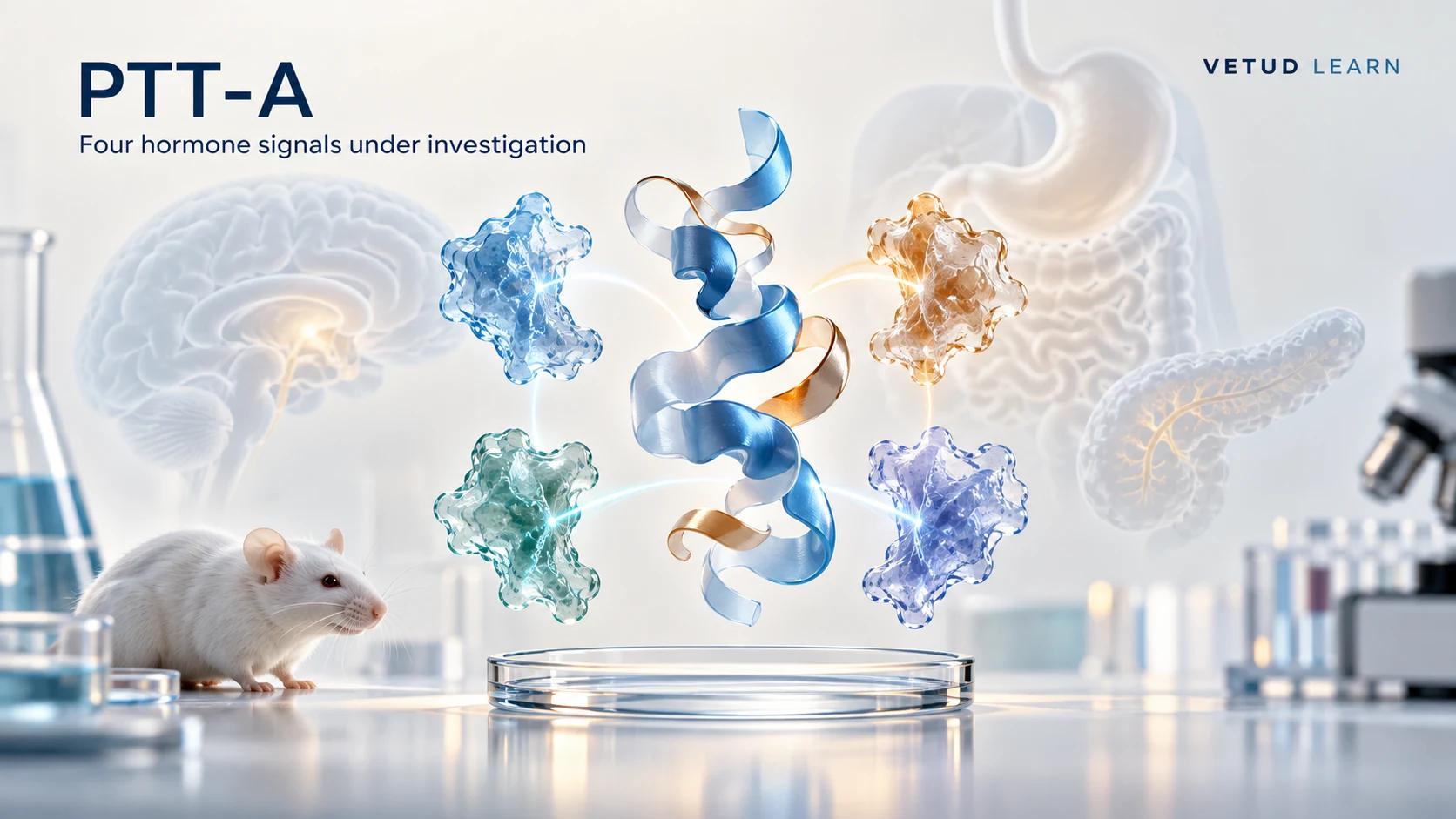
PTT-A, CBL-514 and Adipotide: evidence so far

These findings do not provide comparable average human body-weight-loss results. Animal body weight and human fat volume measure different things, so they are shown separately from the bars.

Animal research · conference abstract

PTT-A

Average human body-weight loss
Not established in the cited research
What was measured
Body weight in diet-induced obese rats over 21 days
Reported finding
Body weight was 19.2% lower versus vehicle at the higher studied exposure; tirzepatide was 12.1% lower versus vehicle in the same experiment.

A difference versus vehicle in rats is not average weight lost by people. It cannot establish superiority to retatrutide in humans.

Human fat-volume subgroup · conference report

CBL-514

Average human body-weight loss
Not established by this fat-volume result
What was measured
MRI-measured visceral-fat volume, four weeks after final treatment
Reported finding
Visceral-fat volume fell 12.01%; placebo rose 5.68%. The small phase 2 subgroup had 40 participants with later follow-up data.

12.01% less visceral fat is not 12.01% less body weight. CBL-514 is an experimental small molecule, not a peptide.

Animal research · peer-reviewed study

Adipotide

Average human body-weight loss
Not established; no results posted for the registered phase 1 study
What was measured
Body weight, body fat and insulin resistance in obese monkeys
Reported finding
A 2011 study reported weight loss and improved insulin resistance in obese monkeys. This is an animal result, not a measured weight-loss benefit in people.

The animal study also found kidney tubular injury. The registered phase 1 study in men with prostate cancer and obesity enrolled four people and was terminated. It does not establish safety or weight-loss effectiveness in people.

News & articles

New research, explained.

Recent studies and decisions, written so anyone can follow them, with every source linked.

Videos

Doctors explain.

Hand-picked videos, mostly from doctors, including some skeptical ones.

Nick Norwitz

The science behind Ozempic and other GLP-1 medications

How GLP-1 medicines work in the gut and brain, in clear language.

Nick Norwitz, MD, PhD

Watch on YouTube

Peter Attia MD

Pros and cons of GLP-1 weight-loss drugs

Two doctors weigh the benefits against the downsides, including muscle loss and cost.

Peter Attia, MD, with diabetes researcher Ralph DeFronzo, MD

Watch on YouTube

Doctor Mike

Exposing the truth about peptides

A practicing doctor looks at the peptide trend and separates the evidence from the hype.

Mikhail Varshavski, DO, family medicine physician

Watch on YouTube